Annual Roseland Cottage Fine Arts and Crafts Festival Reviews
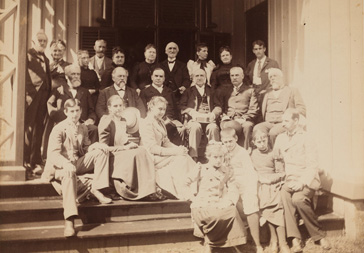
Bowen family unit on porch of Roseland Cottage, Woodstock, Conn., on the 4th of July, with President William McKinley.
A Summer Land Retreat for the Bowens
Henry Chandler Bowen (1813-1896) was born and raised in Woodstock, Connecticut. As a young man in the 1830s Bowen left his hometown for New York to pursue his interests in business organization. Later on serving as a clerk for several years with the successful Arthur and Lewis Tappan silk merchants, Bowen, along with another onetime Tappan clerk, ready upward their own dry appurtenances business, specializing in silks. Bowen'due south strong work ethic and sharp business acumen helped to make the new venture a success.
After establishing himself financially, Bowen married Lucy Maria Tappan, daughter of Lewis and Susanna Tappan, in 1844. Henry and Lucy welcomed their first child, Henry Elliot Bowen, in 1845. Their family continued to grow over the side by side two decades. Ultimately, Henry and Lucy had 10 children: seven boys and iii girls.
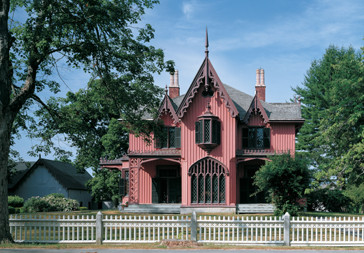
As their family grew, the Bowens wanted to found a summer land retreat and then that the family could escape the stifling oestrus and congestion of New York. Woodstock, Connecticut, with its rural rolling hills, cool ponds, and deep family history, was an platonic location. In 1845 Bowen commissioned Joseph C. Wells, the English-born architect who designed Bowen'due south Plymouth Church in Brooklyn Heights, to design a summertime domicile for the family unit. Joseph C. Wells designed a fantastic five-sleeping accommodation, 6,000-square-foot Gothic Revival cottage. The architectural style and plans of the house, as well as the grounds depicted in Wells' original drawings, were in line with the theories and writings of Andrew Jackson Downing, a popular nineteenth-century American mural architect. The Gothic Revival summer house, called Roseland Cottage by the family, was completed in the fall of 1846. At the time of construction, an next railroad vehicle befouled, complete with a private indoor bowling alley, and a detached woodshed were also congenital in the Gothic Revival style.
In 1850, presently after the family unit started summering in Woodstock, the Bowens planted a colorful and nearly 3,000-square-foot boxwood parterre garden. The garden, as depicted in Joseph C. Wells' drawings, sits prominently in front of the cottage and can be appreciated from the parlors, dining room, and second-flooring bedrooms. According to Henry Bowen's detailed orders the garden comprised 600 yards of boxwood hedge which surrounded twenty-one beds of more than than 30-5 varieties of perennials and thousands of annuals. Roseland Cottage's formal parterre has been an important feature of the house and landscape ever since.
The growing Bowen family returned to Woodstock and Roseland Cottage every summer in the mid-nineteenth century. In line with the Bowens' Congregationalist values, their time at Roseland Cottage offered fresh air, wide open up spaces, and the opportunity for clean and moral activities. The Bowen boys were securely interested in sports and other energetic activities that reinforced ideas of masculinity and class in the late nineteenth century. They participated in newly popular sports such as polo, croquet, bowling, golf, and badminton, as well as more conventional outdoor pursuits similar hunting and fishing.
Lucy Bowen and her three daughters engaged in quieter outdoor activities and other domestic and social pastimes. In a letter sent to a friend in June 1854, Lucy Bowen recounts her summers at Roseland Cottage: "Only one week since nosotros arrived here and found every thing looking beautifully indeed – Now, nosotros are all settled for the summer, and how rapidly information technology will pass…After breakfast, each solar day, sisters & myself read French for an hour & then in the afternoon, read History or something of that nature…The residue of the day is spent in riding, eating, sleeping, sewing & thinking."
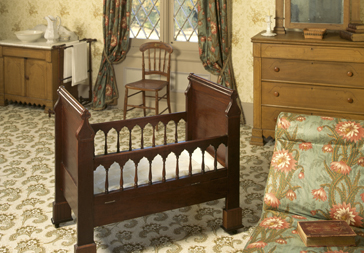
In 1863 Lucy Bowen died due to complications related to the birth of her tenth child, Winthrop Earl Bowen.
 Growing Family and Influence
Two years after the expiry of his first wife and soon after the untimely expiry of his youngest son, Henry Bowen married Ellen Holt of Pomfret, Connecticut, a neighboring town to Woodstock. Ellen was the daughter of a well-known country physician and a member of the local gentry. She not just shared Bowen's conservative moral views, but as well embraced his ambitious business and political interests. Ellen Holt Bowen became a loving and proud mother to Henry and Lucy'south 9 surviving children and in 1868, she and Henry had a son, Paul Holt Bowen. Ellen happily filled the role of an upper-course wife and mother. She served as a gracious hostess and readily traveled with Henry for social engagements, and did not question Henry's lavish spending or tastes.
Throughout the second half of the nineteenth century, the Bowen family continued to seek the quiet serenity and comfortable luxury that their summertime cottage in Woodstock afforded. The family continued to grow during these years. Non only did Henry and Ellen have a son, but several of the older Bowen children were married and had children of their own. As the family grew to include ten children and seventeen grandchildren, they could no longer all find comfort at Roseland Cottage alone. Seeking to keep his family together for summer retreats, in 1878 Henry Bowen purchased Plaine Hill, the elegant estate built in 1816 by his grandfather, William Bowen. Plaine Hill, located less than a quarter mile from Roseland Cottage, immune the entire Bowen family to enjoy summers in Woodstock.
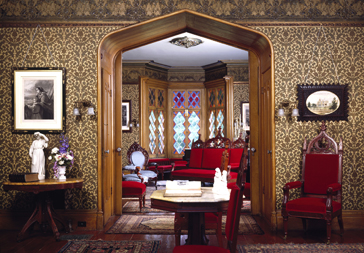
During the 1870s Bowen expanded Roseland Cottage and its outbuildings to conform his growing family unit, the expansion of agricultural pursuits, and frequent social gatherings. In the 1860s and 1870s he purchased lots surrounding the cottage, expanding the holding to approximately half-dozen acres. In 1870 the service ell of the house was expanded to include a full laundry room, butler'due south pantry, scullery, and more bedrooms for paid alive-in staff. Around the aforementioned time, an additional outside privy was built and the next barn was significantly expanded to accommodate livestock and additional staff housing. In the 1880s, after summering at Roseland Cottage for nearly forty years, the Bowens undertook a major redecoration of the firm. Fireplace tiles were updated with the latest decorative styles, the parlor windows were refurbished with colored etched glass, new and vibrant carpets were laid, and impressive new wall coverings, called Lincrusta Walton subsequently the inventor Fredrick Walton, were hung in all the principal entertaining rooms of the house.
While Roseland Cottage was primarily a family country retreat, during the second half of the nineteenth century the Bowens more ofttimes entertained distinguished guests and hosted large festivities at Roseland Cottage. The most notable of these festivities were Henry Bowen's grand 4th of July parties. Initiated in 1870 equally a fashion to promote patriotism, Bowen's Independence Day celebrations continued for twenty-five years. Hundreds were invited, and thousands gathered for the festivities that included food, elegant decorations, festive music, and stirring patriotic orations. 3 United states presidents, Ulysses S. Grant, Benjamin Harrison, and Rutherford B. Hayes, and three past and time to come presidential candidates, John C. Fremont, James G. Blaine, and William McKinley, in addition to a long list of senators, congressman, governors, and other political, literary, and social luminaries, fabricated their way to Woodstock to participate in these Fourth of July events. Somewhen these events grew so large that Bowen purchased an approximately sixty-acre bundle in Woodstock and developed an elegant public park, replete with gilded fountains, decorative statuary, windmill, boat house, and private bungalows, in which to host his Fourth of July celebrations. The park, named Roseland Park, was first opened in 1876 and in accord with Bowen's will is notwithstanding open up to the public today.
The Bowens' active social agenda was a result of Henry Bowen'due south growing wealth and influence as a New York businessman and activist. After his dry goods business organisation failed leading upwardly to the Ceremonious War, in large role due to his anti-slavery views and difficulties with Southern clients, Bowen pursued a number of other successful business organization ventures. He co-founded and served equally a managing director of a profitable insurance visitor. He founded and later served as editor of a popular anti-slavery weekly newspaper, The Independent, and for a period of fourth dimension, he was the appointed tax collector for the Third District of the State of New York. While not a politician himself, Bowen was actively engaged in politics. As an abolitionist and an early supporter of the Republican party, Bowen, and his newspaper, became important players in regional and even national politics equally the political party gained strength in the mid- and tardily nineteenth century.
 Standing Family Traditions
After Henry and Ellen Bowen passed away in 1896 and 1903, respectively, Roseland Cottage was passed onto their children. Ultimately 3 of their children, Edward (known as Ned), Franklin, and Mary Bowen Holt, would maintain buying. The three siblings and their families continued to summer at Roseland Cottage and stayed on for longer respites at times. As in the Bowens' time, Roseland Cottage continued to exist a location for family gatherings.
Betwixt 1910 and 1920 the Bowen children updated the outdated utilities at Roseland Cottage to provide a yr-round retreat. These updates included bringing in electricity, modern plumbing, and an oil-fired central heating system. As well the utility updates, the second generation of Bowens fabricated few changes to the interior or exterior of Roseland Cottage. A few modest changes were made to the landscape. The lattice contend that originally surrounded the parterre garden was removed, probable due to rot, and a quaint classical garden house was erected at the edge of the parterre.
After the deaths of Ned, Mary, and Franklin, Roseland Cottage was passed on to the third generation of Bowens in 1940. Roseland Cottage was deeded to Henry Holt, Mary Bowen Holt's eldest son and Henry C. Bowen'due south grandson. Henry Holt, however, never lived at Roseland Cottage. Rather, as provided in Mary Bowen Holt's will, his two unmarried sisters, Constance and Sylvia Holt, were the primary residents of the grand pinkish cottage. Miss Constance and Sylvia lived at Roseland Cottage year-round and they carefully preserved the family home and its contents, making very few changes to the estate. After Sylvia died suddenly in 1945, Constance Holt remained at Roseland Cottage with a few trusted live-in staff. Similar her grandad, Constance was agile in the community, near notably as a strong supporter of the Woodstock Academy, the area's secondary school, and its students. At the age of 80-nine, Constance passed away in 1968. She was the last Bowen family member to call Roseland Cottage home.
 Condign a Museum
After the death of Constance Holt in 1968, the family decided to sell the estate. The superior historic integrity of the structure and landscape, coupled with the completeness of the Bowen object and archival collections, offered an exceptional view into a piece of New England's history and architectural heritage. Historic New England recognized that significance and set out to preserve the holding and the Bowen family unit story so as to share it with generations to come.
In 1970, the holding was purchased by Celebrated New England with the assist of local and state agencies and has been open up every bit a museum since. The Bowen family collection, including original furniture, china, glassware, books, artwork, clothing and archival documents, were donated to Historic New England as part of the auction.
Since 1970 Historic New England has undertaken a number of interior and exterior restoration projects to preserve the structure and collections at Roseland Cottage. Projects in the 1970s and 1980s largely focused on repairing and rehabilitating structural and decorative elements, every bit well as making improvements to the drainage on the property, in an try to stalk futurity harm. During this aforementioned period Historic New England, with the assist of Dr. Rudy Faveretti, professor of landscape compages at the University of Connecticut, undertook a significant rehabilitation of the Bowen's formal parterre garden. With meticulous field work and background research, the garden as seen today very closely reflects the garden laid out past Henry C. Bowen more than than 150 years ago. In 1977 Roseland Cottage was nominated to the National Register of Historic Places.
In the 1990s Historic New England utilized land-of-the-art techniques and equipment to assist in the preservation of the Bowen family unit collection and enhance the museum feel. A computerized climate control organization was installed and an all-encompassing paint analysis was performed. In recent years, Historic New England has focused on telling a more consummate story of the Bowen family unit and their fourth dimension at Roseland Cottage. Several rooms in the house have been reinterpreted to more fully include the lives of the Bowen women. Portions of the service ell, and the history of the staff that worked for the Bowens, are now incorporated as function of the regular bout.
Roseland Cottage, designated a National Historic Landmark in 1992, remains i of the nation'due south best preserved examples of Gothic Revival architecture. Roseland Cottage provides visitors a glimpse of the lifestyle and tastes of an upwardly mobile, ambitious, and shut-knit family during the Victorian era.
Source: https://www.historicnewengland.org/property/roseland-cottage/
0 Response to "Annual Roseland Cottage Fine Arts and Crafts Festival Reviews"
Post a Comment